Energy efficiency has moved from a "nice to have" to a central concern for both landlords and tenants. From April 2023, all new tenancies must have an Energy Performance Certificate (EPC) rating of E or above, with proposals (subject to legislation) to raise this to C for new tenancies from 2025. Tenants are increasingly choosing properties with better EPC ratings as energy costs remain elevated. Here is a practical guide to improving your property's heating efficiency.
Understanding EPC Ratings
An Energy Performance Certificate rates a property from G (least efficient) to A (most efficient). The rating is calculated based on the property's construction, insulation, heating system, glazing, and other factors.
The rating directly affects:
- •Legal minimum standards for lettings
- •Your tenants' fuel bills
- •Your property's rental and sale value
- •The attractiveness of your property to environmentally-conscious tenants
Most older properties without recent improvement work fall in the D-E range. Getting from E to D — let alone from D to C — requires targeted investment in the right areas.
The Biggest Gains: Where to Invest
The EPC calculation gives the most credit for the following improvements, in approximate order of impact:
1. Insulation
Insulation improvements provide the largest single improvements in EPC ratings and real-world energy efficiency:
Loft insulation: If your property has an accessible loft with less than 100mm of existing insulation, topping up to 270mm (current recommended standard) is the single best investment you can make. Cost: £200-600. Potential EPC impact: 5-10 points. Energy saving: 15-25% of heating costs.
Cavity wall insulation: Most properties built between 1930 and 1995 with cavity walls are candidates for cavity wall insulation. Cold beads or blown mineral fibre is injected into the wall cavity. Cost: £400-1,500. Potential EPC impact: 10-15 points.
Solid wall insulation: For pre-1930 solid brick or stone properties without cavities, external or internal insulation is the solution. This is more expensive but can be transformative: External: £5,000-15,000. Internal: £4,000-10,000.
Floor insulation: Suspended timber floors can lose significant heat through draughts and lack of insulation. Adding insulation below floorboards: £500-1,500 for a typical property.
2. Boiler and Heating System Upgrades
Replacing an old boiler: Boilers manufactured before 2003 are almost certainly non-condensing and running at 70-80% efficiency. A modern condensing boiler runs at 89-94% efficiency. Replacing an old boiler can save hundreds of pounds per year in gas bills. New boiler supply and installation typically costs £2,000-4,000.
Thermostatic Radiator Valves (TRVs): Fitting TRVs to all radiators allows the heating system to maintain different temperatures in different rooms. Unused rooms can be kept cooler, saving energy. Cost: £15-30 per radiator installed by a plumber.
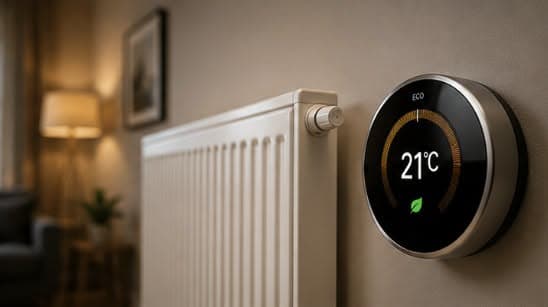
Smart controls and programmers: A smart thermostat (like Hive, Nest, or Tado) allows precise temperature control and often includes weather compensation and occupancy sensing. These typically save 10-15% on heating bills. Cost: £150-300 installed.
Power flushing: A heating system with dirty, sludge-laden water is inefficient and puts additional strain on the boiler. Power flushing cleans the system, improves heat distribution, and can extend boiler life. Cost: £400-800 depending on system size.
3. Hot Water Efficiency
Hot water cylinder insulation: If your property has a hot water cylinder (common in older properties), ensure it has an insulating jacket. Modern cylinders are insulated as standard; older ones may not be. Jacket cost: £20-30.
Reducing pipe run lengths: Long, uninsulated hot water pipe runs waste energy. Pipe lagging is a simple, cheap fix: £50-200 for a full property.
4. Glazing
Secondary glazing: Where planning restrictions prevent double glazing replacement (conservation areas, listed buildings), secondary glazing — an inner pane fitted behind the existing window — can achieve similar thermal performance for lower cost: £200-500 per window.
Double glazing replacement: If your property still has single glazing or very early double glazing (pre-2000), replacement is worthwhile both for EPC rating and tenant comfort: £400-800 per window for standard uPVC.
5. Draught Proofing
One of the cheapest and most immediately effective measures. Draught proofing doors, windows, letterboxes, and loft hatches costs £100-300 for a full property and can reduce heating bills by up to 10%.
Heat Pumps: The Future of Property Heating?
Air source heat pumps (ASHPs) are increasingly being proposed as a replacement for gas boilers in the context of decarbonisation. They extract heat from outside air and deliver it to the property at 3-4 times the efficiency of a direct electric heater.
However, heat pumps are not currently suitable for all properties:
- •They require good insulation to operate efficiently (ideally EPC C or above before installation)
- •They work best with larger radiators or underfloor heating
- •Installation cost is £8,000-15,000, partially offset by the Boiler Upgrade Scheme (BUS) government grant of £7,500 (as of 2024)
- •Running costs are lower in well-insulated properties but can be higher in poorly insulated ones
For landlords considering a heat pump, we recommend an energy assessment first to establish whether your property is a suitable candidate.
Minimum EPC Standards and Exemptions
The current minimum EPC requirement for rental properties in England is E. Properties rated F or G cannot legally be let unless an exemption applies. Exemptions include:
- •Where improvement would cost more than £3,500 (though this cap may be raised)
- •Where planning permission for works is refused
- •Listed buildings where works would unacceptably alter their character
If your property cannot reach E for less than £3,500, register an exemption with the PRS Exemptions Register. This is temporary, however — future legislative changes may require higher investment.
Getting Started
An EPC assessment costs £70-120 and identifies specific recommendations for your property with estimated improvement values. This is the logical starting point for any improvement programme.
Premier Property Solutions works with Gas Safe engineers and qualified insulation installers to deliver heating system upgrades across Kent and South East London. We can project manage improvement programmes from assessment through to installation and EPC re-assessment.
Call 01322 251520 to discuss energy efficiency improvements for your property.
Premier Property Solutions
Property maintenance specialists serving Dartford, Kent and South East London since 1996.